
Famous last words heard by houseplants:
“Bright indirect light?” This spot seems bright enough.
Are you using GROW LIGHTS? Go to this page:
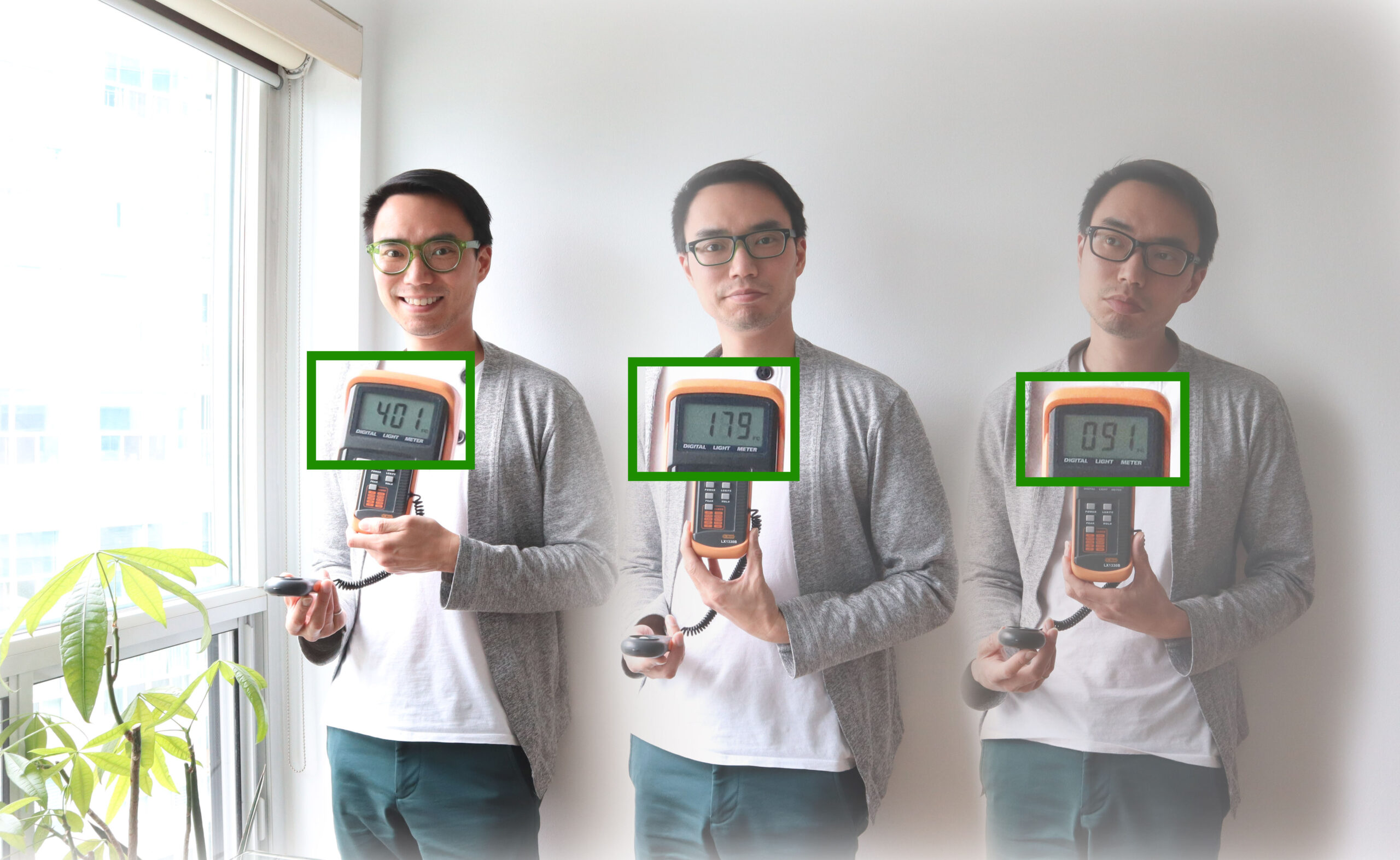
Your interior light levels form the growth potential of the plant. Your care efforts realize that potential (watering, fertilizing, repotting). Good light is the PREREQUISITE for a plant to grow but the term “bright indirect light” fails to convey anything concrete.
The worst part is the term “bright indirect light” makes you think just any place the sun doesn’t shine is considered indirect light. And our eyes adjust to a wide range of light levels so you will NOT feel the difference.
Instead, those with huge, unobstructed windows and/or skylights are patting themselves on the back at how good they are with houseplants while those with smaller windows living between buildings are struggling to figure out why their fiddle leaf fig always ends up with 90% of their foliage lost.
After measuring light, I realized there’s no such thing as a ‘greenthumb’ – just people with large, unobstructed windows.
Step 1: Get a light meter and get to know how bright your indirect light actually is.
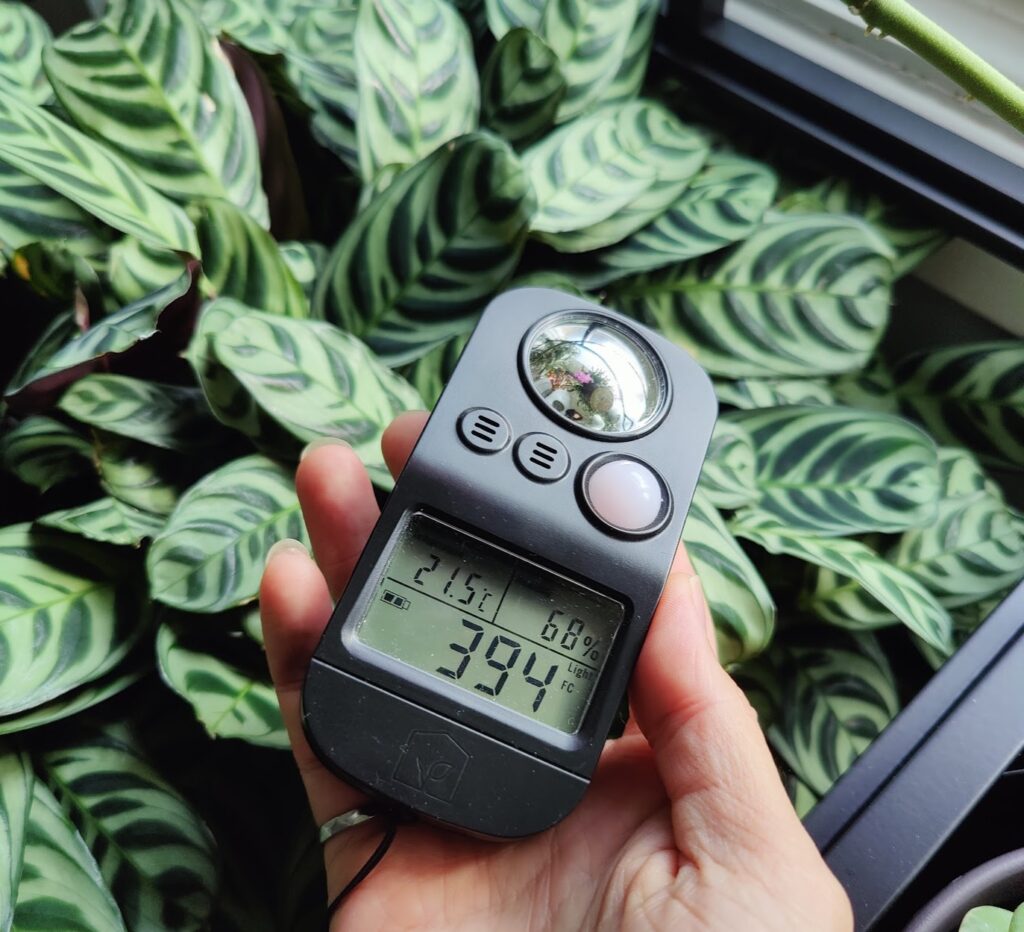
A light meter is so critical to understanding light that I designed and manufactured my very own:
The LTH Meter
Light | Temperature | Humidity
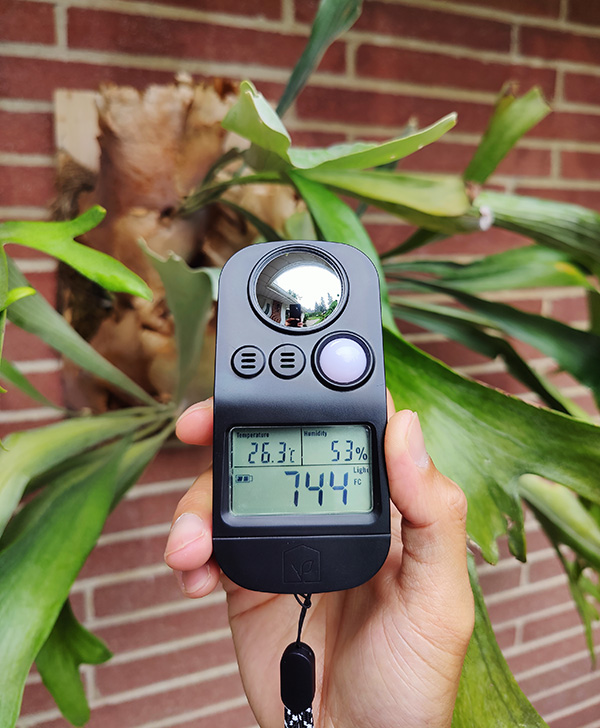
I designed and manufactured the LTH Meter with houseplant owners in mind. When you know your light situation, you will know where to put plants (and where NOT to put plants) – and you can start using grow lights properly!
Disclaimer: this article contains Amazon Affiliate links. Earnings from qualifying sales goes to support the work of House Plant Journal – thank you!
This is the Dr. Meter LX1330B Light Meter that I used before. It’s not as compact as the LTH Meter, has limited measuring ranges (need to manually select the range), and does not measure temperature and humidity. The pricing has been varying wildly on Amazon but it should be around $40-60 [US Link] [CAN Link]. An alternate model: [US Link] [CAN Link]
What about apps? Android devices do not have standardized ambient light sensor hardware and the iOS platform doesn’t give access to the iPhone light sensor, which means those apps are doing a rough calculation based on the camera brightness value. An app might be able to give you a rough idea, but a dedicated device will do the proper cosine correction for the angle of incident light (that’s what the white dome is for).
Step 2: Bookmark this page so you can look up the levels of indirect light necessary for various plants. I don’t have every possible houseplant but after reading a few of these, I think you’ll get the idea.
Interior Light Levels: plants can technically survive in a wide range of light levels so do not take the numbers listed here as prescriptive – they aren’t strict requirements. You should think of them as guidelines for good growth. Another consideration is that “good growth” is subjective as any plant will take the shape of its light situation – up to a certain point, it’s not entirely under your control! These numbers are gathered from my own observations and measurements. ***Use these as guidelines.***
How to measure natural light – need to assess 2 parameters:
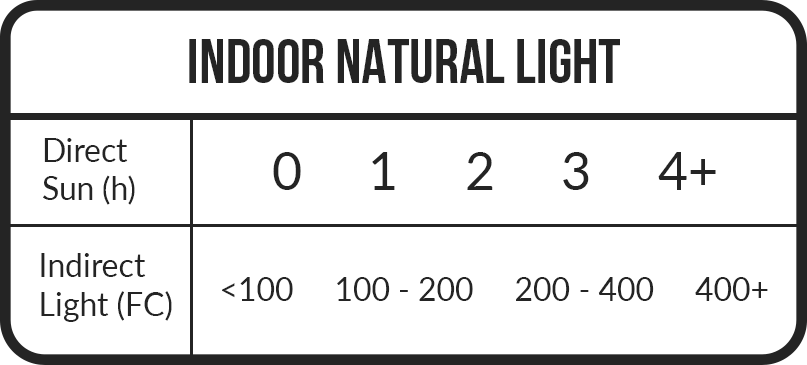
Imagine you’re a plant sitting in front of a window. When it is day time, as the sun moves across the sky (and sometimes clouds get in the way), there are 2 light situations you care about:
1) When the sun shines directly on the plant: when you measure direct sun through a window, you’ll get readings in the range of 3000 to 8000 FC depending on the angle of the sun and the transparency of the window – the thing you want to take note of is the DURATION – how long is the sun shining directly on the plant? One hour? 2 hours; 3 hours or more? You only need to estimate this to the nearest hour (doesn’t have to be down to the minute). KEY POINT: compare this with column 1 of the table for your particular plant. If the duration exceeds the tolerance of your plant, then you should diffuse the sun with a sheer curtain (which should reduce the light strength to 1000 – 3000 FC)
2) When the sun is not shining on the plant: at other times of the day, this would be considered “indirect light”, which is all the light diffused through the sky and lands on your plant. This is where I developed the saying “let your plant see as much of the sky as possible” (note: it’s not just “let your plant see the sky” – as much as possible is the key) – the wider the view of the sky, the stronger the indirect light will be. This effect is most noticeable when you measure – use a light meter and as you move away from the window, the reading decreases rapidly.
Take multiple measurements throughout the day during the “indirect light” times of the day. Take measurements on different days with different degrees of cloud cover. Categorize your growing location by using the following ranges:
- Under 100 FC most of the day (< 20 µmol/s/m²)
- 100 – 200 FC most of the day (20-40 µmol/s/m²)
- 200 – 400 FC most of the day (40-80 µmol/s/m²)
- 400 + FC most of the day (80 + µmol/s/m²)
Remember, this must be done for each plant – you can’t apply it for the entire window because small changes in distance cause big changes in light levels!
Analysis for natural light:
- If the duration of direct sun is above the “Direct Sun Duration (tolerance)”, then block it with a white sheer curtain
- If the duration of direct sun is at or below the “Direct Sun Duration (tolerance)”, then there’s no need to block the plant (just be sure to keep up with watering)
- If the strength of indirect light is below the “Minimum Indirect Light Levels”, the move your plant closer to the window (or get grow lights)
- If the strength of indirect light is above, then it should grow well – the stronger the indirect light, the better!
Note on FC (foot-candle) vs PPFD (PAR Photon Flux Density)
After using a spectrometer, I realized that illuminance (FC and lux) and PPFD correlate nicely for natural light and white LED light (approximate PPFD = 0.2 x FC – for those two light sources). So as long as you’re using either of those light sources, you can use whatever light meter you have (traditional foot-candle/lux or PAR meter) and refer to the chart.
Discrepancies between FC and PPFD only arise when using these grow lights:
- Red/Blue (“blurple”) LED grow lights
- Ceramic metal halide
- High pressure sodium
- Fluorescent
So you can expect good growth results even if measuring with a traditional foot-candle meter as long as you’re using either natural light or white LED lights.
Note: the full unit of PPFD is “µmol/s/m²” but, for this chart, it is shortened to “µmol”
Looking for a sensible and logical approach to houseplant care?
Find it here:
| Plant | Direct Sun Duration (tolerance) | Minimum Indirect Light Levels | Good Indirect Light Levels | Comments |
|---|---|---|---|---|
| African Violets | 2-3 hours direct sun is tolerable | 200 FC (40 µmol) | 400 FC (80 µmol) | |
| Aglaonema (Chinese Evergreen, and several species) | 1-2 hours direct sun is tolerable | 100 FC (20 µmol) | 200 FC (40 µmol) | Classical “low light” tolerant houseplant. Plant dies slowly below 100 FC and will look ugly after a year or two. |
| Air Plants (Tillandsia – many species) | 3-4 hours direct sun is tolerable | 200 FC (40 µmol) | 400 FC (80 µmol) | my air plant care video here https://youtu.be/sjNVLgEbvOY |
| Alocasia (several species) | 3-4 hours direct sun is tolerable | 200 FC (40 µmol) | 400 FC (80 µmol) | Leaves will very likely die back. Calmly repot the base into fresh soil and new leaves may sprout. |
| Anthurium (several species) | 1-2 hours direct sun is tolerable | 100 FC (20 µmol) | 200 FC (40 µmol) | |
| Aspidistra (Cast-Iron Plant) | 1-2 hours direct sun is tolerable | 100 FC (20 µmol) | 200 FC (40 µmol) | Classical “low light” tolerant houseplant. Plant dies slowly below 100 FC but will look fine for many months, possibly years. |
| Areca Palm | 3-4 hours direct sun is tolerable | 200 FC (40 µmol) | 400 FC (80 µmol) | |
| Arrowhead Vine (Syngonium podophyllum) | 2-3 hours direct sun is tolerable | 100 FC (20 µmol) | 200 FC (40 µmol) | |
| Begonia (several species) | 1-2 hours direct sun is tolerable | 200 FC (40 µmol) | 400 FC (80 µmol) | |
| Bird-Of-Paradise (Strelitzia) | 4-5 hours direct sun is tolerable | 400 FC (80 µmol) | 800 FC (160 µmol) | |
| Calathea (several species) | 1-2 hours direct sun is tolerable | 200 FC (40 µmol) | 400 FC (80 µmol) | |
| Ceropegia woodii (String of Hearts) | 1-2 hours direct sun is tolerable | 200 FC (40 µmol) | 400 FC (80 µmol) | Leaves get bigger with nicer variegation with higher light |
| Cordyline (Ti Plant) | 3-4 hours direct sun is tolerable | 200 FC (40 µmol) | 400 FC (80 µmol) | |
| Croton (several species) | 4-5 hours direct sun is tolerable | 400 FC (80 µmol) | 800 FC (160 µmol) | |
| Dieffenbachia (Dumb cane; several species) | 3-4 hours direct sun is tolerable | 100 FC (20 µmol) | 200 FC (40 µmol) | |
| Dracaena (several species) | 3-4 hours direct sun is tolerable | 100 FC (20 µmol) | 200 FC (40 µmol) | Very low-light tolerant – I’ve seen one last for years at 30-50 FC. It had very long, thin and dark green spindly foliage but it was alive. |
| Plant | Direct Sun Duration (tolerance) | Minimum Indirect Light Levels | Good Indirect Light Levels | Comments |
|---|---|---|---|---|
| English Ivy (Hedera helix) | 2-3 hours direct sun is tolerable | 200 FC (40 µmol) | 400 FC (80 µmol) | lower leaves will drop off – generally doesn’t look nice after a year. |
| Haworthia, Haworthiopsis | 3-4 hours direct sun is tolerable | 200 FC (40 µmol) | 400 FC (80 µmol) | |
| Hoya (several species) | 3-4 hours direct sun is tolerable | 100 FC (20 µmol) | 200 FC (40 µmol) | |
| Ferns (Boston Fern, Bird’s Nest Fern, Maidenhair Fern) | Bird’s nest fern/maidenhair fern – 1-2 hours direct sun is tolerable but must keep soil evenly moist | 100 FC (20 µmol) | 200 FC (40 µmol) | my Maidenhair fern care video here: https://youtu.be/Q1FecMy2zXE |
| Ficus (Rubber plant, elastica; Fiddle leaf fig, lyrata; benjamina) | 3-4 hours of direct sun is tolerable | 400 FC (80 µmol) | 800 FC (160 µmol) | if you don’t have at least 400 FC of indirect light, your fiddle leaf fig will lose most of its lower leaves. If you have small windows, save your money. |
| Fittonia (Nerve Plant) | 1-2 hours direct sun is tolerable but must keep soil evenly moist | 100 FC (20 µmol) | 200 FC (40 µmol) | |
| Jade Plant (Crassula ovata, other Crassula) | 3-4 hours direct sun is tolerable | 200 FC (40 µmol) | 400 FC (80 µmol) | Book "Tropical Foliage Plants" by Lynn P. Griffith Jr. - https://www.houseplantjournal.com/recommended-product/reference-books/ |
| Maranta (Prayer Plant) | 2-3 hours direct sun is tolerable | 100 FC (20 µmol) | 200 FC (40 µmol) | |
| Money tree (Pachira aquatica) | 2-3 hours direct sun is tolerable | 100 FC (20 µmol) | 200 FC (40 µmol) | Money trees will become leggy in lower light conditions, which will require pruning sooner. |
| Monstera deliciosa | 2-3 hours direct sun is tolerable | 100 FC (20 µmol) | 200 FC (40 µmol) | my detailed monstera care article – https://www.houseplantjournal.com/2017-1-25-monstera-deliciosa-house-plant-journal/ |
| Norfolk Island Pine | 2-3 hours direct sun is tolerable | 200 FC (40 µmol) | 400 FC (80 µmol) | |
| Parlour Palm (Chamaedorea) | 1-2 hours direct sun is tolerable | 100 FC (20 µmol) | 200 FC (40 µmol) | |
| Peace Lily (Spathiphyllum) | 1-2 hours direct sun is tolerable | 100 FC (20 µmol) | 200 FC (40 µmol) | Very “low light” tolerant – down to 50 FC, but will just barely survive and have high risk of root rot. Overall plant will gradually lose leaves and become thinner in low light. My peace lily care video – https://youtu.be/GpIsAhmWDbQ |
| Peperomia (many species) | 2-3 hours direct sun is tolerable | 100 FC (20 µmol) | 200 FC (40 µmol) |
| Plant | Direct Sun Duration (tolerance) | Minimum Indirect Light Levels | Good Indirect Light Levels | Comments |
|---|---|---|---|---|
| Phalaenopsis (Moth Orchid) | 2-3 hours direct sun is tolerable | 200 FC (40 µmol) | 400 FC (80 µmol) | |
| Philodendron Vines (Heart-leaf, Brasil, etc) | 2-3 hours direct sun is tolerable but leaves may lose color. | 100 FC (20 µmol) | 200 FC (40 µmol) | Very “low light” tolerant – down to 50 FC, but will just barely survive. |
| Philodendrons (Moonlight, Imperial Red, Prince of Orange, Pink Princess, etc.) | 2-3 hours direct sun is tolerable | 200 FC (40 µmol) | 400 FC (80 µmol) | |
| Pilea (peperomioides, Aluminum plant, cadierei and others) | 2-3 hours direct sun is tolerable | 200 FC (40 µmol) | 400 FC (80 µmol) | Pilea peperomioides leaves develop flatter (nicer) when light levels are higher. |
| Polka Dot Plant (Hypoestes) | 2-3 hours direct sun is tolerable | 200 FC (40 µmol) | 400 FC (80 µmol) | should be cut back every few months to keep bushy, otherwise will grow leggy. |
| Pothos (Epipremnum aureum, Scindapsus pictus) | 3-4 hours direct sun is tolerable | 100 FC (20 µmol) | 200 FC (40 µmol) | Very “low light” tolerant – down to 50 FC, but will just barely survive. |
| Sansevieria (Snake Plant, Mother-in-law’s Tongue) | 5-6 hours direct sun is tolerable | 100 FC (20 µmol) | 200 FC (40 µmol) | Very “low light” tolerant – down to 50 FC, but will just barely survive and be at high risk of root rot. New leaves grown at low light levels will be long, thin and floppy. |
| Schefflera (Mini Umbrella Tree, Schefflera arboricola; Umbrella Tree, Brassaia actinophylla) | 2-3 hours direct sun is tolerable | 100 FC (20 µmol) | 200 FC (40 µmol) | |
| Schlumbergera, Rhipsalidopsis (Christmas, Thanksgiving, Easter Cactus) | 3-4 hours direct sun is tolerable | 200 FC (40 µmol) | 400 FC (80 µmol) | |
| Spider Plant (Chlorophytum) | 2-3 hours direct sun is tolerable | 200 FC (40 µmol) | 400 FC (80 µmol) | |
| Staghorn Fern (Platycerium) | 3-4 hours direct sun is tolerable | 200 FC (40 µmol) | 400 FC (80 µmol) | my staghorn fern care video here: https://youtu.be/bTM3WLwfq78 |
| Succulents (Aloe, Echeveria, Euphorbia, etc.) | 5-6 hours direct sun is tolerable | 400 FC (80 µmol) | 800 FC (160 µmol) | Aloe and Euphorbia can stay looking mostly the same down to 200 FC; Echeveria will stretch when grown indoors after several months – it’s inevitable. You can propagate by taking leaf cuttings and stem tip cutting – they simply do not stay compact and cute forever. Here’s a video on succulent leaf propagation: https://youtu.be/laAtQf8kwEA |
| Yucca | 3-4 hours direct sun is tolerable | 400 FC (80 µmol) | 800 FC (160 µmol) | often confused with Dracaena fragrans (Corn Plant), which is far more low-light tolerant. Yucca will not perform well below 400 FC. |
| ZZ Plant (Zamioculcas zamiifolia) | 3-4 hours direct sun is tolerable | 100 FC (20 µmol) | 200 FC (40 µmol) | often classified low-light tolerant, ZZ plant will survive with 50 FC but will be at high risk of root rot. |
Get your LTH Meter HERE


Hi! thanks for the super useful info, already bought a light meter to get into this game 🙂 I can’t understand one thing from the table and the comments: how many hours of given FC levels plants need? Now many hours is this table calculated for?
Hello,
we have a dracaena reflexa Anita houseplant in a dark corner of our apartment. During winter, this corner gets even darker. As we noticed that the plants starts to lose leaves, we got ourselves a LED lamp on a stand around 20 cm above the dracaena, to see if this would improve things. The lamp has 30 W and around 2900 lumen at 6500 K. Could this lamp be too bright? We’ve noticed that some of the leaves are getting brown/yellow-discolorations, but we aren’t sure if this is due to the lamp or because we kept the plant so long in darkness before getting the lamp (3-4 days ago). What do you think? Is it possible to burn a plant with articial light? Also: We are using the lamp 10 hours / day. Would this be too long as well? Are there any studies on length and intensity of led illumination for different plant types?
I appreciate your effort. You are creative in your work
What is the meaning of the symbol FC What does it represent. And what is the basis of the word if it is an abbreviation of a sentence
FC = foot-candles
This is very useful information for people who wants to really understand how to care for plants. Thanks much for the links provided. Best information I was looking for! This makes is easier to understand my plant needs.
I came across your channel on YouTube and I need some guidance. Should we be measuring indoor artificial lights with PAR or LUM to get the best light for the plants during FALL/WINTER? I am reading on stuff about LUMENS at that LUMENS are measured for human eyes and not plant photosynthesis because it does not contain enough amount of red or blue. Please correct me on this. And if I were to measure the FC, how would you measure it for low/medium/high indirect light?
Hi Richard – I’ll probably need to make a video on this but for now, I’ll try to give you some clarity here:
– PAR is measuring all light between 400-700 nm with equal sensitivity.
– Illuminance is measuring all light between 400-700 nm with highest sensitivity near 560 nm (green) and falling off in a bell-curve shape.
So it’s not quite correct to say that illuminance “does not contain enough red/blue” – illuminance is about what wavelengths the measure is sensitive to, it doesn’t contain anything.
The real implication is illuminance measurement may not reflect “strong or weak” ***if the measured light contains very high blue or red.***
But here’s why you don’t need to worry about this: WHITE light, such as natural light or white LED light, will have a generally balanced spectral distribution of blue, green, and red, so a higher reading of foot-candles/lux will also be a higher reading of PPFD. Basically, illuminance and PAR are *correlated* as long as the spectrum is relatively balanced (which means, the light is mostly white).
The only situation where you will run into a major discrepancy is with purely blue and red light. Your illuminance value will be very low but a PPFD reading will be high. But since there is no real benefit to using purely red/blue light compared to white light, this is of no practical concern.
As for correlating FC reading to low/medium/high indirect light? I don’t. If you look at the “Commercial Light Levels” column, there’s nothing below 1000 FC, which means *ALL* houseplants will grow extremely well if you can get indirect light levels to be as close to 1000 FC as possible. Realistically, they’ll grow nicely in the 400-800 FC range, acceptable in the 200-400 FC range, and just survive if it never gets higher than 200 FC: that’s my take if you’re looking for my version of broad categorizations. High, medium, low are meaningless.
Hope this helps!
Hi Darryl!
Thank you so much for constructing this. It’s been an amazing resource as I’ve started getting into growing and collecting some pretty plants.
I’ve recently acquired a musa ae-ae. Any lighting tips for that one? TIA
Mason 🙂
Hi everyone, I’m really impressed by the useful information here which are illustrated in simple ways so everyone even inexperienced person can understand.
My name us Dr.Raghda Ramadan, I’m specialized in overcoming indoor air pollutants using green plants, specially in closed workplaces where we spend more than 8 hours daily leading to many side effects of being unattached to nature.
I wish we can cooperate in some workshops coz I’m very willing to encourage people grow green plants in their spaces either home or work .
Darryl, I love your book, and this list is so helpful. Any idea of the light requirements (specifically how many hours of direct sunlight tolerated) for tradescantia zebrina?
Have made some adjustments of various plant locations after reading your book, and am seriously considering getting a light metre to makes sure all my plants are getting what they need. Thanks for sharing your learning!
Sincerely,
kmilne
Thanks, Kelly! T. zebrina grows well in “shade” outdoors, which means up to 3 hours of direct sun is fine – remember that the gardening definition of “shade” does NOT mean complete absence of direct sun, it means less than 3 hours of exposure time. If you’re growing this plant indoors, just put it in your biggest *and* sunniest window.
This is a great source! Thanks, Darryl!
[…] Here’s my list of common houseplants and their light requirements – WITH NUMBERS! […]
Darryl this table is amazing 😍 thank you so much for doing this 🙌!! I’d love to see a new column with the average amount of hours per day needed to achieve that Good Growth.
As a product manager getting into houseplants, I love this! Read your book too and it’s the best houseplant book I’ve read so far.
Thanks, Emma! Glad you found it helpful!
How many hours in a day does a Ficus (I recently got a large rubber plant) need at least 400 fc to keep up maintenance? Likewise, how many hours in a day does it need 800 fc for good growth?
Hi Claire! I’d say roughly 8 hours.
What is the minimum time the plants (moth orchids) need to spend in the light for it to be considered enough… have only limited shelf at the window and might have to start rotation thing … also can’t leave it open whilst the orchids are there as I am worried that the draft will kill them .
The range of light intensity/duration varies a lot. If you want orchids to flower around once year, I’d say they need to be exposed to at least 200-400 FC for at least 6 hours a day. An hour or two of direct sun would be great as well. That’s going to be as close to your biggest window as possible. As for the draft – if there is one, you should have it fixed for the sake of your heating/cooling bill.
Just wanted to say thanks for putting together this resource. Similar to one of the comments above, I ended up using this list frequently and created a sortable table for it – feel free to use it if it’s helpful 🙂
https://airtable.com/shrcr8Dw6n4HRoStv
When I originally commented I clicked the “Notify me when new comments are added” checkbox and now each time a
comment is added I get four e-mails with the
same comment. Is there any way you can remove me from that service?
Thanks!
We’re very sorry for the emails! We only recently had our website re-done and so we’re still figuring out the issues.
Is there any link within the email that says “unsubscribe”?
When I look on the commenting part of the page, I don’t see a checkbox that says “Notify me when new comments are added.” but rather, only one that says “Save my name, email, and website in this browser for the next time I comment.” – was that the one you checked?
Please let us know. We’ll do our best to help!
I have referred back to this list SO many times I’ve considered turning it into a sortable list by light levels. Please keep adding to it *begs sweetly* !!
Muito bom, estas informações irão contribuir muito para as minhas pesquisas!
Very informative, thank you! ♥
This is some very nice information and I happen to have some cheap chinese light meter, hopefully it gives me at least some idea of the light levels I have. But I was just wondering how long do the light levels have to be above or within those light levels? I mean how many hours in a day is enough of say, 100 FC to achieve minimal growth? That’s something I didn’t quite understand.